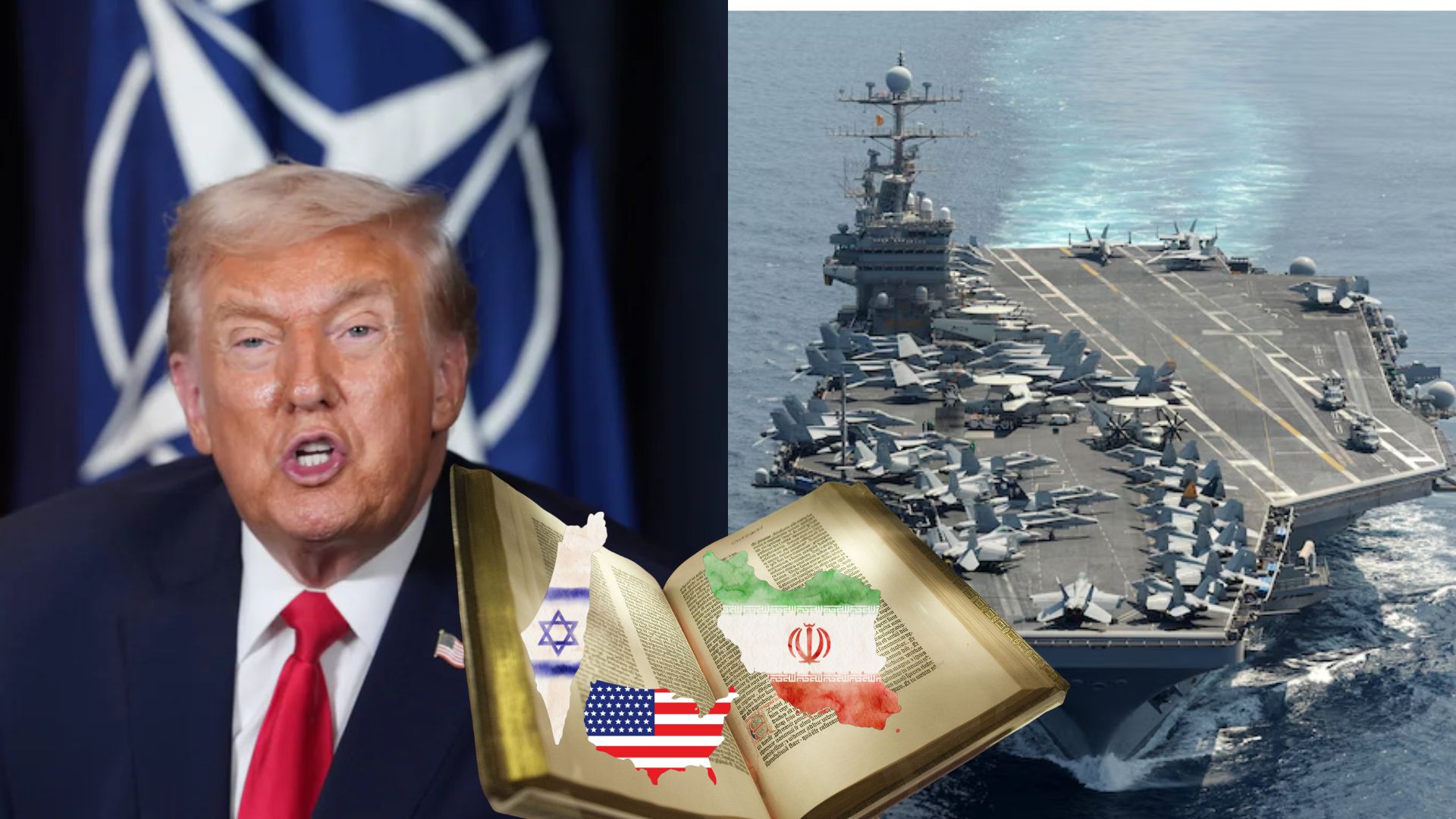
A massive United States naval fleet is moving towards the Persian Gulf, and Turkish officials are now warning Iran that Israel is reportedly looking for an opportunity to strike. Most people missed why this truly matters. But if you know biblical prophecy, especially the ancient warnings about Persia and the nations surrounding Israel, this should make you pause and pay very close attention.
Today, we are witnessing a significant acceleration of events in the Middle East, particularly concerning the long-standing tensions between Israel and Iran. This week, reports have confirmed the movement of a massive United States naval fleet into the Persian Gulf region. This deployment, according to official statements, is described as a measure to ensure maritime stability, deter aggression, and protect United States interests and allies in a volatile region. This fleet reportedly includes an aircraft carrier strike group, accompanied by multiple destroyers, cruisers, and a significant complement of air assets, indicating a robust and formidable military presence.
This substantial military posture by the United States comes at a critical juncture. The Turkish Foreign Minister, Hakan Fidan, has reportedly conveyed specific warnings to Tehran. These warnings, according to international media outlets and diplomatic sources, indicate that Israel is actively “looking for an opportunity” to launch a direct attack on Iranian targets. Such a communication from a significant regional power like Turkey underscores the heightened state of alert and the tangible risk of direct conflict that currently characterizes the geopolitical landscape of the Middle East. Turkey, maintaining complex diplomatic relationships with both Israel and Iran, often serves as a conduit for sensitive messages and warnings, suggesting the seriousness with which these threats are being perceived.
Simultaneously, Iran itself is grappling with severe internal unrest, which has been widely reported by international news agencies and human rights organizations. For months, various cities across Iran have seen widespread protests, initially sparked by social grievances, but quickly evolving into broader demands for political and economic reform. These demonstrations have been met with harsh crackdowns by the Iranian regime, involving significant deployments of security forces, mass arrests, and reports of casualties among protestors. These actions have drawn strong condemnation from numerous international bodies and governments, citing severe human rights abuses and suppression of dissent. The internal pressures on the Iranian government are considerable, creating a complex dynamic where external threats converge with domestic instability. This internal turmoil, impacting both the social fabric and economic stability of the nation, adds another layer of unpredictability to the region’s current state.
In Washington, President Trump has publicly affirmed that the United States is “watching Iran” extremely closely. His statements have included stark warnings regarding any potential Iranian actions that could destabilize the region or threaten American interests and allies. These public pronouncements have been consistently firm. However, reports from diplomatic circles and intelligence sources also suggest that these public warnings are running concurrently with “back-channel diplomatic signaling.” While the precise nature and content of these back-channel communications remain undisclosed, their existence indicates an effort to manage escalation, perhaps by defining red lines or exploring potential off-ramps in what is an increasingly tense standoff. This dual approach of public warnings and private diplomacy highlights the delicate balance the United States is attempting to strike in its engagement with Iran.
The confluence of these elements—a powerful United States naval deployment, explicit warnings from regional mediators, significant internal instability within Iran, and a dual-track approach from the United States presidency—paints a picture of extreme volatility. Analysts across the political spectrum have noted the unparalleled level of tension currently gripping the region, with the potential for miscalculation or unintended escalation remaining a persistent concern. Each of these verifiable facts, reported extensively across global news networks, contributes to a rapidly shifting and profoundly uncertain situation in a historically combustible part of the world.
We have just outlined the raw facts, the undeniable headlines screaming from our screens and newspapers. But as I always say on this channel, the world is not falling apart; it is falling into place. And it is in moments like these, when the drumbeat of war echoes so loudly in the Middle East, that we must turn our gaze from the fleeting headlines to the eternal words of God. We must connect the dots, not with speculation or sensationalism, but with sober, scriptural truth.
When we consider the intensifying standoff between Israel and Iran, coupled with the massive deployment of American naval power and the internal turmoil within Iran itself, our minds are immediately drawn to several critical prophecies. Jesus Himself, in Matthew chapter twenty-four, gave us clear signs of the times. In verse six, He says plainly, “And ye shall hear of wars and rumours of wars: see that ye be not troubled: for all these things must come to pass, but the end is not yet.”
What we are witnessing is precisely this: not merely wars, but the rumours of them, the constant threat, the posturing, the diplomatic maneuvering behind the scenes even as the rhetoric intensifies. The very language used by world leaders, the warnings issued by foreign ministers about Israel “looking for an opportunity,” these are the very fabric of “rumours of wars.” They are not the final cataclysm, but they are undeniable indicators of the escalating tension, the tectonic plates of geopolitics shifting beneath our feet. This isn’t just about two nations; it’s about the entire region, and indeed, the world, being drawn into a vortex of potential conflict. Jesus told us these were part of the “beginning of sorrows,” or as some translations put it, “the beginning of birth pangs.” Just as birth pangs grow closer together and more intense, so too do these geopolitical spasms. We are feeling the contraction, and it is quickening.
But let us go deeper, to a prophecy that is remarkably specific concerning the very players we are seeing on the stage today: Ezekiel chapters 38 and 39. This ancient prophecy describes a future war, often referred to as the War of Gog and Magog, where a coalition of nations will attack Israel. The details are astonishingly precise, naming specific nations that would align against the Jewish state “in the latter days.”
Let us consider the primary antagonist described by Ezekiel. In chapter 38, verse 2, it says, “Son of man, set thy face against Gog, the land of Magog, the chief prince of Meshech and Tubal, and prophesy against him.” While “Gog” is identified as a leader, “Magog” is a land. Most credible Bible scholars, looking at historical and linguistic evidence, link “Magog” to the descendants of Japheth who settled north of the Black Sea, in what is now modern-day Russia. And what do we see today? Russia’s increasing presence and influence in the Middle East, its alliances, its military support for certain regimes, and its often-antagonistic relationship with Western powers and Israel. The stage is being set for “the chief prince of Meshech and Tubal,” a northern power, to be at the helm of this prophesied alliance.
Then, Ezekiel lists other nations that will join this formidable coalition. In Ezekiel 38, verse 5, it explicitly states: “Persia, Ethiopia, and Libya with them; all of them with shield and helmet.” Here it is, stark and clear: “Persia.” There is no debate among scholars that “Persia” in biblical times is the geographical region we know today as modern-day Iran. Think about that for a moment. Thousands of years ago, a prophet in exile pinpointed “Persia” as a key player in a climactic end-times war against Israel.
And what are the headlines telling us? That “tensions in the Middle East have reached a critical point” specifically involving Israel and Iran. We see Iran’s long-standing animosity towards Israel, its funding of proxy groups like Hezbollah and Hamas, its relentless pursuit of nuclear capabilities, and its stated goal of eradicating the Jewish state. Now, add to this the reported warnings from Turkey’s Foreign Minister to Tehran that “Israel is looking for an opportunity to attack,” and you have a volatile mix that perfectly aligns with a nation described as standing “with them” against Israel.
Furthermore, Ezekiel 38 verse 5 also mentions “Ethiopia” and “Libya”. These are nations in North Africa, and their alignment with Russia and Iran today is a matter of public record. Russia has expanded its influence in Africa, including securing military agreements and establishing bases in these regions. We also see “Gomer, and all his bands; the house of Togarmah of the north quarters, and all his bands: and many people with thee” (Ezekiel 38 verse 6). Gomer and Togarmah are often identified as ancient peoples tied to modern-day Turkey and parts of Central Asia. And where is Turkey today? A significant player, sometimes an uneasy ally, sometimes a clear antagonist in the region, with its own ambitions and often-strained relationship with Israel.
The picture Ezekiel paints is not a vague one; it’s a precise geographical and political alignment that is increasingly mirroring the geopolitical realities of our present day. The forces Ezekiel foretold, the nations he named, are coalescing. They are forming alliances, they are making pronouncements, and they are escalating tensions in ways that defy mere coincidence.
But what would be the motivation for such a vast coalition to attack Israel? The prophetic text offers an answer: “To take a spoil, and to take a prey; to turn thine hand upon the desolate places that are now inhabited, and upon the people that are gathered out of the nations, which have gotten cattle and goods, that dwell in the midst of the land.” This speaks of Israel’s remarkable prosperity and rebirth. Since its modern re-establishment in nineteen forty-eight, Israel has transformed a barren land into a technological powerhouse, an agricultural miracle, and recently, a significant energy producer with vast offshore natural gas fields. This immense wealth and strategic positioning could easily become the “spoil” and “prey” that drives an avaricious coalition.
And when does this attack happen? “In the latter days,” the prophecy states. This is a clear indicator of its prophetic timing, aligning with other end-times prophecies. It also describes Israel as “dwelling safely” when this attack occurs. This is a point of discussion among scholars. Does “dwelling safely” mean a time of true peace and security, perhaps after a peace treaty, or even a false sense of security that the world gives them? Or does it refer to the incredible confidence Israel has in its own military might, or perhaps a temporary respite from constant conflict? Regardless of the precise interpretation, the overarching theme is a dramatic, unprovoked attack on a re-gathered Israel that is prosperous. And the internal unrest within Iran, as detailed in our news segment, could even be seen as a catalyst – a regime desperate to deflect internal pressure by igniting an external conflict. The idea that a nation like Iran, consumed by its own turmoil, might lash out or be drawn into a larger conflict to distract its populace, is certainly a possibility that aligns with prophetic warnings of chaos.
Beyond Ezekiel, these escalating tensions also contribute to the conditions described in the book of Revelation. The constant threat of regional war, the mobilization of global powers, the whispers of greater conflicts to come – these are all part of the birth pangs that will ultimately lead to a world desperate for a global solution, a strong leader who promises peace and stability where there is none. This brings us to Daniel chapter 9, where the prophet speaks of a future “prince that shall come” who will confirm a covenant with many for one week, or seven years. This figure, commonly understood to be the Antichrist, will rise to power in a world riddled with conflict and instability. The very conditions we see today – the fear of widespread war, the economic uncertainties, the desire for an ultimate resolution to age-old conflicts – these are precisely the circumstances that would pave the way for such a figure to emerge and offer a “solution.” A global war or a series of escalating regional conflicts could very well be the impetus for the world to accept a false peace brokered by such a powerful, charismatic leader.
We are watching, in real-time, the geopolitical chessboard being set. The pieces are moving into place. The nations mentioned in prophecy are not abstract concepts; they are sovereign states with leaders, armies, and current events that align with ancient scriptures. This is not about fear; it is about discernment. It is about taking heed of the signs that Jesus Himself told us to watch for. The “world is not falling apart; it is falling into place” for the culmination of God’s prophetic plan. The precision of these prophecies, unfolding before our very eyes in today’s headlines, should sober us, not scare us. It should spur us to watch with even greater vigilance, understanding that our sovereign God is meticulously orchestrating every event toward His ultimate purpose.
Now, I want to be clear with you. I am not here to scare you. That is not my purpose, and it never will be. I am here, instead, to remind you of something fundamentally important: Jesus Himself told us that these very things would happen. He knew the path that history would take, and He gave us His Word as our compass.
In Matthew chapter 24, verse 6, Jesus said, “And ye shall hear of wars and rumours of wars: see that ye be not troubled: for all these things must come to pass, but the end is not yet.” Did you catch that vital phrase? “See that ye be not troubled.” Why should we not be troubled when we see such dramatic and potentially devastating events unfolding on the global stage? Because, as watchmen, we are informed. We understand that these are not random acts of chaos, but rather the precise unfolding of a divine plan laid out thousands of years ago.
This is why our mantra, “The world is not falling apart; it is falling into place,” is so crucial. When we see nations like Iran, ancient Persia, embroiled in internal unrest, facing external pressures, and seeing a massive naval presence from nations like the United States heading towards the Persian Gulf, we are not looking at unprecedented instability. We are looking at puzzle pieces aligning with remarkable accuracy.
Consider the prophecy in Ezekiel chapter 38. The Lord commanded Ezekiel, in verse 2, “Son of man, set thy face against Gog, the land of Magog, the chief prince of Meshech and Tubal, and prophesy against him.” And then in verse 4, we read, “And I will turn thee back, and put hooks into thy jaws, and I will bring thee forth, and all thine army…” Think about those “hooks in the jaws.” Could the internal strife within Iran, coupled with the pressure from the United States and the perceived threat from Israel, be the very “hooks” that compel Persia onto the stage exactly as prophecy foretold? It certainly bears a sobering resemblance.
Then, in Ezekiel 38, verse 5, the Word of God explicitly names a critical player in this end-times coalition against Israel: “Persia, Ethiopia, and Libya with them; all of them with shield and helmet.” Persia is modern-day Iran. We are witnessing the very nations, the very geopolitical tensions, described with chilling accuracy thousands of years ago.
And for whom is this coalition ultimately gathered? Verse 8 of Ezekiel 38 answers this: “After many days thou shalt be visited: in the latter years thou shalt come into the land that is brought back from the sword, and is gathered out of many people, against the mountains of Israel, which have been always waste: but it is brought forth out of the nations, and they shall dwell safely all of them.” The re-establishment of Israel, “gathered out of many people” and “brought forth out of the nations,” is an undeniable signpost of these latter days. Its very existence, surrounded by these prophesied antagonists, confirms the prophetic timeline.
So, when I speak of these things, it is not to create fear. It is to ignite discernment, to anchor your faith in the infallible Word of God, and to affirm that what we are seeing is not the world unraveling, but rather the intricate tapestry of prophecy meticulously weaving itself together. The world is not falling apart; it is falling into place.
If you’re watching these signs—these escalating tensions in the Middle East, these movements of nations—and feeling a stirring, a sense of uneasiness within you, understand this: that is not fear. That is awareness. The Lord Jesus Himself told us, in Matthew chapter twenty-four, to watch for these very things. He said, “When ye shall see all these things, know that it is near, even at the doors.” And He then cautioned, “Therefore be ye also ready: for in such an hour as ye think not the Son of man cometh.”




Leave a Reply